






 BooksCLASSIFICATION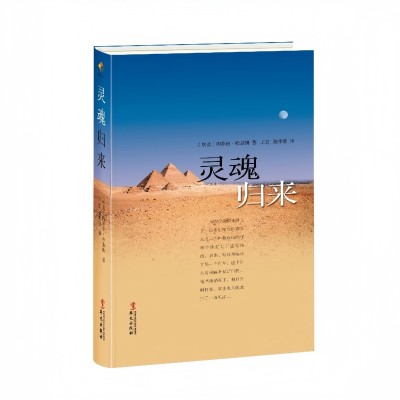
Title: The Return of the Spirit
Author: Tawfiq al-Hakim (Egyptian)
Translators: Wang Fu, Lu Xiaoxiu
Publisher: Sino-Culture Press
Edition: 1st Edition, June 2016
Format: 16 - mo Binding: Soft - hardcover
Printed Sheets: 19 Word Count: 200,000 characters
ISBN: 9787507545494
Price: 48.00 CNY
Arabic literature, due to him, changed the situation where poetry was the sole dominant form. It now has its own comedies, short stories, and novels. --Naguib Mahfouz, Nobel laureate in Literature
The novel The Return of the Soul is the representative and debut work of Tawfiq al - Hakim. This novel pioneered realism in Egyptian novels. Published in 1933, it was originally written in French and later translated into Arabic by the author himself. This autobiographical social novel depicts the national movement in the era of Saad Zaghloul in Egypt. Through the twists and turns of a character and his family, it presents the entire Egyptian society in the first ten - odd years of the 20th century to the readers.
The protagonist of the novel, Muhsin, is young, promising, and talented. He lives in his uncle's house in Cairo in order to study. Muhsin deeply falls in love with the beautiful daughter of a retired officer. Unexpectedly, his uncle secretly has the same feelings for the girl. Later, the girl marries another young man. This blow is heavy for Muhsin. He becomes depressed, listless all day long, and a turmoil ensues in the family...
Tawfiq al - Hakim was born in Egypt in 1898. He is an Egyptian novelist and playwright. He once served as a full - time member of the Supreme Council of Literature and Arts in Egypt. Later, he was elected as the president of the Egyptian Writers' Association and a member of the Arabic Language Academy. He has received the Egyptian National Honor Award and the title of "Best Thinker and Writer in Mediterranean Countries". His autobiographical novel The Return of the Soul is his debut work and an important realist work in the history of modern Egyptian literature. In addition, he has written more than a dozen novels such as Notes of a Village Prosecutor, A Little Bird from the East, The New Woman, The People of the Cave, The Hesitant Sultan, A Deal, In a Flash, and several short - story collections.
Wang Fu, born in 1945, is a senior translator. He graduated from the Arabic Department of the Faculty of Oriental Languages and Literatures at Peking University in 1969. From 1979 to 1981, he studied at the Faculty of Arts of the University of Baghdad. He once served as the chief editor of the Arabic version of China Today magazine of the China Foreign Languages Publishing Administration. He has published over 80 translation works in different fields, including novels, poetry, literary criticism, culture, history, philosophy, medicine, and religion. For example, his literary works include A Sad Smile (Syria), Reflections on Turning Seventy (Lebanon), Muqam (China), etc.; literary criticism like Literature and Literary Criticism (Bahrain), etc.; poetry such as The Mu'allaqat (Arabic ancient book), Characters and Colors (Saudi Arabia), Selected Poems of Chen Yi (China), etc.; history books like A General History of the Jews (Egypt), etc.; and philosophy works like The Sons of the Awakened People Live Forever: The Story of Hayy ibn Yaqzan (Arabic ancient book), etc.
At the same time, he has been responsible for translating and finalizing a large number of important foreign - publicity books, documents, and white papers, covering politics, economy, military, science, history, geography, painting, architecture, art, etc., such as the documents of the 16th and 17th National Congresses of the Communist Party of China, The Taiwan Question and China's Reunification, The Basic Law of Hong Kong, Xi Jinping: The Governance of China, etc.
In 1994, he won the "Lebanese Literary Translation Award". In 1996, he began to enjoy the "Special Government Allowance" issued by the State Council. In 2005, he won the May 1st Labor Medal of the Central Government Departments. In 2008, he received the "China Publishing Honorary Medal" issued by the General Administration of Press and Publication. In 2009, he was awarded the "National March 8th Red - Banner Holder" by the All - China Women's Federation. In 2011, he received the "Senior Translator Honorary Certificate" from the Translators Association of China. In 2014, he won the first prize in the Arabic category of the First China Modern Literature International Translation Competition. He is currently the deputy director of the Arabic Expert Committee of the National Translation Professional Qualification (Level) Examination Expert Committee. He has been appointed as an expert of the Expert Committee of the Inter - ministerial Joint Conference on the Standardization of Chinese Translations of Foreign Languages by the National Language Commission.
Currently, he is engaged in the translation, finalization, and review of classics in the "The Chinese Library" project, such as Romance of the Three Kingdoms, Journey to the West, Zhuangzi, Selected Tang Poems, Strange Tales from a Lonely Studio, etc.
Lu Xiaoxiu was born in Shanghai in 1932. He graduated from the Arabic Department of the Faculty of Oriental Languages and Literatures at Peking University in 1956. He is a senior translator, a member of the Translators Association of China, and a former vice - president and current member of the Arab Literature Research Association of the Institute of Foreign Literature, Chinese Academy of Social Sciences. He participated in the compilation of language and film - related reference books such as Arabic - Chinese Dictionary (Peking University edition, 1965), Arabic - Chinese Dictionary (University of International Business and Economics edition, 1986), and Dictionary of Chinese and Foreign Film and Television Masterpieces (deputy chief editor, 1992). He has a large number of translations and works, and is the translator of China's first Brief History of Arab Literature.