






 BooksCLASSIFICATION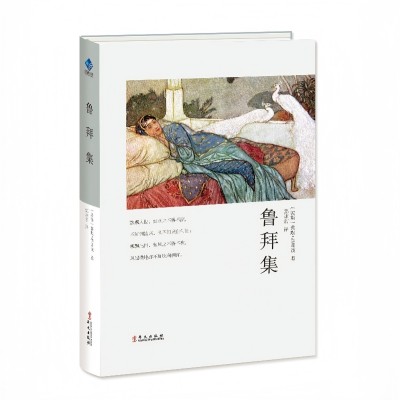
Title: Rubaiyat
Author: Omar Khayyam (Persian)
Translator: Guo Moruo
Publisher: Sino-Culture Press
Edition: 1st Edition, January 2019
Format: Hardcover, 16 - mo
Printed Sheets: 17
Word Count: 150,000 words
ISBN: 9787507550764
Price: 58.00 CNY
Omar Khayyam's work Rubaiyat (literally translated as "Quatrains") has a poetic form similar to the jueju in Chinese poetry. The content mostly reflects the philosophy of life, sighing over the impermanence of prosperity and decline. Beneath the surface of carpe diem, it penetrates life and grasps the essence of life. With its beautiful pure poetry, it expresses the faint sadness of life incisively and vividly. The poems integrate rationality and inspiration, making it a brilliant masterpiece of world classical literature and art.
Omar Khayyam (1040 - 1123) was a renowned Persian poet, astronomer, mathematician, physician, and philosopher. Also translated as "Umar al - Khayyami" or "Omar Khayyam". He wrote many popular quatrains, which were later compiled into Rubaiyat (or The Rubaiyat of Omar Khayyam). His greatest contribution was in the book Algebra, where he proposed the definitions of rational and irrational numbers. He also systematically put forward the theory of using conic sections to solve equations graphically, providing a mathematical method for astronomical calculations and calendar - making. In astronomy, he was ordered to build an observatory, presided over the revision of the ancient Persian calendar, and compiled the Jalali Calendar Tables. He was not well - known for his poetry during his lifetime. His quatrains were discovered 50 years after his death. In 1859, the British writer Edward FitzGerald translated his quatrains into English and published them, after which they spread around the world.
Guo Moruo (1892 - 1978), whose original name was Guo Kaizhen, was from Leshan, Sichuan. He was a famous romantic poet, historical playwright, archaeologist, and paleographer in the history of modern Chinese literature. He started writing new - style poetry in 1918. In 1921, he organized the "Creation Society" with Yu Dafu, Cheng Fangwu, Zhang Ziping, etc., and published his first poetry collection The Goddess, which was a foundational work of new - style poetry. After the founding of the People's Republic of China, he served as the chairman of the All - China Federation of Literary and Art Circles, the president of the Chinese Academy of Sciences, etc. His representative works include Studies on Oracle Bone Inscriptions, Qu Yuan, Tiger Tally, The Bronze Age, etc.
One Hundred and One Poems / 001
Postscript / 223
Appendix: Selected Translations of Rubaiyat in Chinese / 225