





 BooksCLASSIFICATION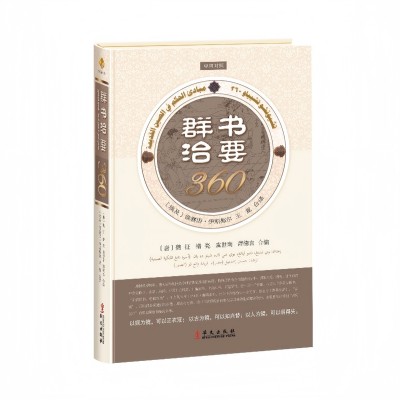
Title: 360 Gems from "Essentials of Governing from the Classics" : Chinese - Arabic
Authors: Wei Zheng, Chu Liang, Yu Shinan, Xiao Deyan (Tang Dynasty)
Translators: Hussein Ismail (Egyptian) , Wang Fu
Publisher: Sino-Culture Press
Edition: 1st Edition, August 2016
Format: 16 - mo Binding: Soft - hardcover
Printed Sheets: 24.25 Word Count: 250,000 characters
ISBN: 9787507545661
Price: 48.00 CNY
In the early years of the Zhenguan reign of the Tang Dynasty, Emperor Taizong of Tang, Li Shimin, ordered the remonstrance official Wei Zheng, Yu Shinan, etc. to collate historical materials on how emperors of past dynasties governed the country. They extracted the essence regarding self - cultivation, family regulation, state governance, and bringing peace to the world from the Six Classics, the Four Histories, and various philosophical works. Starting from the Five Emperors and ending with the Jin Dynasty, they "selected from numerous books and removed the excessive and unrestrained parts" from over 14,000 ancient books with more than 89,000 volumes. The compilation was completed in the fifth year of the Zhenguan reign (631 AD), consisting of 65 books with approximately 500,000 words, named "Essentials of Governing from the Classics". "Essentials of governance" refers to the outlines, theories, and methods that must be followed in governing the country. This book was not only an important theoretical basis for Wei Zheng to admonish Emperor Taizong but also the ideological source and reference for governance for Emperor Taizong to create the "Reign of Zhenguan".
360 Gems from "Essentials of Governing from the Classics" (Chinese - Arabic Bilingual Edition) organizes the wise sayings in "Essentials of Governing from the Classics" into six general outlines: The Way of the Ruler, The Skills of Ministers, The Importance of Virtue, Governance, Prudence, and Discernment. Each general outline contains several sub - items, which provide valuable guidance and reference for modern people's virtues, cultivation, work, study, and life.
Wei Zheng (580 - 643), with the courtesy name Xuancheng, was an outstanding statesman, thinker, and historian in the early Tang Dynasty. In the first year of the Zhenguan reign, he was promoted to the Left Minister of the Department of State Affairs. In the second year of the Zhenguan reign, Wei Zheng was appointed as the Supervisor of Secretariat and participated in government affairs. During this period, he was ordered to compile "Essentials of Governing from the Classics", which was completed in the fifth year of the Zhenguan reign. In the sixteenth year of the Zhenguan reign, Wei Zheng passed away at home. Emperor Taizong personally attended the funeral, crying bitterly, and said, "Using copper as a mirror, one can correct one's attire; using history as a mirror, one can understand the rise and fall of dynasties; using people as a mirror, one can know one's own mistakes. I have always kept these three mirrors to prevent my own mistakes. Now that Wei Zheng has passed away, I have lost one of my mirrors."
Chu Liang (555 - 647), with the courtesy name Ximing, was from Qiantang, Hangzhou. He was one of the Eighteen Scholars in the early Tang Dynasty. At the beginning of the Zhenming reign, he served as the Attendant of the Department of State Affairs. After the fall of the Chen Dynasty, he entered the Sui Dynasty and became a Bachelor of the Crown Prince's Palace. In the fourteenth year of the Daye reign, when Li Shimin, the Prince of Qin, defeated Xue Ren'gao, the son of Xue Ju, Chu Liang was appointed as the Military Secretary of the Armor Department. Later, he entered the Literary Academy of the Prince of Qin's Palace and served as a Bachelor of the Literary Academy. In the first year of the Zhenguan reign (627 AD), he and Du Ruhui, etc. were appointed as Bachelors of the Hongwen Academy.
Yu Shinan (558 - 638), with the courtesy name Boshi, was from Yuyao, Yuezhou. He was a famous calligrapher, litterateur, poet, and statesman from the Southern and Northern Dynasties to the Sui and Tang Dynasties, and one of the Twenty - four Meritorious Officials of Lingyan Pavilion. After Li Shimin defeated Dou Jiande, he recruited Yu Shinan as a Military Advisor, a Secretary of the Records Office in the Prince of Qin's Palace, and a Bachelor of the Hongwen Academy. Together with Fang Xuanling, etc., he was in charge of literary works and was one of the "Eighteen Scholars". He was good at calligraphy and was known as one of the "Four Great Calligraphers of the Early Tang Dynasty" together with Ouyang Xun, Chu Suiliang, and Xue Ji.
Xiao Deyan (558 - 645), with the courtesy name Wenxing, was from Chang'an, Yongzhou. Xiao Deyan had an extensive knowledge of classics and history, especially proficient in "Zuo Zhuan". He was fond of writing. During the Wude reign, he served as the Crown Prince's Attendant, an official in the Crown Prince's Palace. During the Zhenguan reign, he was appointed as the Compiler of the Bureau of History and also a Bachelor of the Hongwen Academy. Emperor Taizong wanted to know the gains and losses of previous dynasties, so he ordered Wei Zheng, Chu Liang, Yu Shinan, and Xiao Deyan to collect and compile the reasons for the rise and fall of emperors from classics, history, and various philosophical works. The emperor loved the book for its comprehensiveness and conciseness.
Hussein Ismail, a famous Egyptian translator, is the deputy chief editor of the Arabic version of China Today magazine of the China Foreign Languages Publishing Administration.
Wang Fu, born in 1945, is a senior translator. In 1969, he graduated from the Arabic Department of the Faculty of Oriental Languages and Literatures at Peking University. From 1979 to 1981, he studied at the Faculty of Arts of the University of Baghdad. He once served as the chief editor of the Arabic version of China Today magazine of the China Foreign Languages Publishing Administration. He has published more than 80 translation works in different fields, including novels, poetry, literary criticism, culture, history, philosophy, medicine, and religion, such as A Sad Smile, Reflections on Turning Seventy, Muqam, Literature and Literary Criticism, The Mu'allaqat, Characters and Colors, The Sons of the Awakened People Live Forever: The Story of Hayy ibn Yaqzan, etc.
Introduction to "Essentials of Governing from the Classics"
Preface to "Essentials of Governing from the Classics"
I. The Way of the Ruler
(a) Refraining from Greed
(b) Diligence and Thrift
(c) Controlling Anger
(d) Adopting Goodness
(e) Correcting Mistakes
1. Self - cultivation
2. Cherishing Family Ties
3. Self - reflection
4. Respecting the Virtuous
5. Accepting Admonition
6. Preventing Slander and Evil
7. Making Judgments
II. The Skills of Ministers
1. Establishing Integrity
2. Devoting Loyalty
3. Admonishing
4. Recommending the Worthy
III. The Importance of Virtue
……