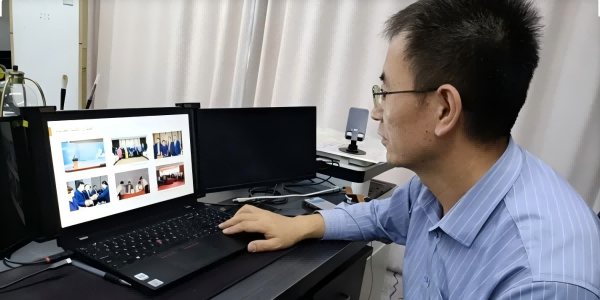
The "Silk Road Library" project helps more Chinese access diverse books to understand different societies and cultures. (Al Jazeera)
Beijing—A story of perseverance in promoting books in China has spanned a decade, beginning in 2014. At that time, Noah Yang returned from studying and working abroad. During the Beijing International Book Fair, where Saudi Arabia was the guest of honor, Noah Yang and a team of translators and editors worked to translate over ten books introducing Saudi higher education, the Grand Mosque in Mecca, the Prophet's Mosque in Medina, the Kiswah (covering of the Kaaba), and other aspects of Saudi Arabia for the Chinese public.
Following this experience, he conceived a three-track project: translating foreign books into Chinese, translating Chinese books into various languages, and republishing Chinese classics and literary works that had been out of print for decades. The core idea of this project is to promote civilizational dialogue by establishing the "Silk Road Library" as a distinguished source of knowledge in China, advocating for "enhancing understanding of the cultures along the Silk Road," "promoting Chinese culture," "enriching the cultural atmosphere of commercial spaces," and "building a platform for scholarly exchange."
Dream Garden Culture and the Silk Road Library
Noah Yang founded "Dream Garden Culture (Beijing) Co., Ltd." in Beijing, a company commercially positioned as a growing cultural enterprise focused on publishing books in humanities, social sciences, literature, biographies, historical documents, Sino-foreign relations, and classic translations. It integrates creativity, compilation, production, and sales.
Together with his wife and partner, Ayesha Wang, he launched this knowledge and civilization initiative, securing official approvals—a crucial requirement for publishing any book in China. He collaborated with publishers such as Huawen and Wuzhou. The uniqueness of this project in China lies in its approach and goal of publishing a series of books from countries along the Silk Road, rather than isolated titles. Most books translated into Chinese in the past were not part of a complete series, thus failing to build a diverse and intellectually cohesive library.
Since books sold in China must be officially published domestically and cannot be imported, this project allows ordinary Chinese people to find diverse books in the "Silk Road Library," helping them understand the societies and cultures of countries along the Silk Road and dispelling negative stereotypes.
Additionally, the library has introduced a new feature for translated books: bilingual editions of classic texts. This bilingual format is rare in previous translated works. This approach not only enhances knowledge exchange but also allows readers to compare the original text with the translation, identifying any errors.
Noah Yang and his wife hail from the central-western region of China, an area some scholars call "the capital of Arabic in China," as over a third of its population belongs to ethnic minorities. Speaking about his dream and project, Yang Ping said, "Our project is like our company's name, 'Dream Garden.' Our dream is to publish 'a thousand books': literature, history, and social sciences, covering various fields. Some of these books were previously published in other formats. In late 2014, we set our first five-year goal of publishing about 100 books and have nearly achieved it. However, when we entered the second five-year plan, we faced the COVID-19 pandemic and other economic challenges, preventing us from fully realizing our goals. But this plan and dream remain alive, and we are still striving to achieve it."
Noah Yang also discussed their working methods: "We publish books according to a rigorous plan, starting with selecting the books, finding suitable translators, having the editorial team review them, then proceeding with layout and design, and finally printing and distribution. Each stage requires funding, time, and team effort."
Noah Yang and his translation and editing team also noticed errors in many foreign book translations, including some translations of classics. Some translations were done through a third language, leading to deviations in many terms and concepts when translated into Chinese, affecting readers' understanding of cultural concepts.
Noah Yang also mentioned the insufficient number of Chinese books on the cultures of countries along the Silk Road, with many books failing to gain widespread circulation. Additionally, many early translations are out of print and may need revision before being republished.
Despite the increasing consumption of visual content through mobile apps, Yang Ping and his team stated that publishing books remains profitable in China due to the lack of sufficient e-books in this field in the virtual world.
Open University and Knowledge Inheritance
Noah Yang emphasized the importance of passing down knowledge and science to the next generation in China. He believes that book publishing is like an open university without walls. He hopes to disseminate books to universities, research institutions, and households. This will have a profound impact on people across different social strata in China.
Knowledge exchange is crucial for Chinese Muslims and the broader Chinese population. Therefore, the Silk Road Library team aims to make their publications an open university without cultural barriers, fostering dialogue between the civilizations of Silk Road countries and Chinese civilization. Through these books, readers can learn about the history and culture of different countries, and even ordinary readers can gain rich literary and scientific knowledge from them.
In 2022, four "Linxiyuan Bookstores" were opened in Shanghai, Ningxia, and Qinghai. However, due to the COVID-19 pandemic and recent economic conditions, these bookstores were forced to close at the end of last year. Currently, books are sold through social media apps and official publishers, with some available in university libraries.
Noah Yang stated, "We believe that 'words from a thousand years ago can still speak.' Book publishing is one of the most cost-effective and widely disseminated methods of cultural communication, serving as an extremely important medium for civilizational and cultural exchange."
The significance of this cultural and scientific work lies in the fact that many buyers of these books are not only professionals but also ordinary people. These books are essential for Chinese experts, policymakers, politicians, and diplomats to understand the cultures of Silk Road countries, especially under the Belt and Road Initiative.
Books Published in Order
In the first phase of the Silk Road Library project, the focus was on literature and novels as an entry point for translating books in this field and promoting civilizational exchange. To date, over 80 books have been published, covering classic works from more than 40 countries.
These include One Thousand and One Nights, Yusuf Al-Sibai's Return My Heart, Ahmed Farid Mahmoud's Love Is Not Enough, Tayeb Salih's Season of Migration to the North, Al-Hariri's Maqamat, Leila Othman's Wasmiya Emerges from the Sea, and Taha Hussein's The Call of the Curlew.
Additionally, there is Gulistan, a Persian literary classic by Saadi from 656 AD, translated into Chinese by the renowned Chinese scholar Wang Jingzhai (1879-1949), the first to translate the Quran into Chinese.
Other translated novels include Ihsan Abdel Quddous's A Man in Our House, Abdelhamid Benhedouga's South Wind, Fouad Al-Takarli's The Distant Echo, Mohamed Abdel Halim Abdullah's After Sunset, Yusuf Idris's The Forbidden, Tawfiq Al-Hakim's The People of the Cave and Return of the Spirit, and Naguib Mahfouz's Palace Walk, Sugar Street, and Children of the Alley.
Travel Books and Chinese Classics
The library has also republished books written decades or centuries ago by Chinese travelers, scholars, and others. For example, Diaries from the West, published in 1932, tells the story of five Chinese students who traveled to Al-Azhar University in Egypt. They were among the first group of Chinese students to study in Egypt in the early 20th century, and the book documents their journey and their efforts to bring books back to Beijing, later collaborating with Chinese scholars such as Cai Yuanpei and Chen Yuan to establish the Fude Library.
Additionally, there is The Travels of Sulaiman, published in 851, about a merchant named Sulaiman who traveled from Basra to China; The China Record, which recounts the journey of a Persian to China during the Ming Dynasty; and Essentials of Governance from the Tang Dynasty (651 AD), translated into Arabic and published in a bilingual format.
Upcoming Publications
The translation and editing team of the Silk Road Library is currently working on the second phase of their project in Beijing. Starting from early 2025, nearly a hundred books, most of which have completed translation and editing, are awaiting publication. This effort aims to serve Western Asian culture in a country like China, which holds significant cultural, demographic, economic, and political importance, while fostering dialogue between Chinese and Western civilizations.
Among the most significant works on this list is the translation and publication of ancient texts, such as The Book of Songs (Shijing), Zhuangzi, Xuan Shi, and the Hadith collections. These classic texts have been translated and are currently under editing and review. They will be published in bilingual format, with each page featuring both the original text and its translation.
The team translating these works includes renowned scholars like Yu Chongren, who completed the translations under extremely challenging economic and health conditions.
Additionally, plans are in place to publish biographies of Malik, Shafi‘i, and Ibn Hanbal, alongside other notable figures from Chinese and foreign history.
The library also plans to release several nearly completed historical works, including The Umayyad Dynasty and The Abbasid Dynasty by Muhammad Khuzayri Bek, as well as The Zangid Dynasty, The Fatimid Dynasty, The Almohad Dynasty, The Seljuk Empire, and The Ottoman Empire by Sarabi, and The Safavid Dynasty by Muhammad Suhail Taqush.
The ambitious plans of the Silk Road Library also include a roughly thousand-page book titled They Are Mothers, Wives, and Daughters, which covers the biographies of women from the Prophet’s household. This encyclopedic work, authored by the renowned Egyptian scholar Aisha Abdul Rahman, was translated by Wang Fu. A student of the late translator Ma Jian, Wang Fu has translated over 80 books, including two volumes of Xi Jinping: The Governance of China by the current Chinese president. She is considered one of the most influential translators between Arabic and Chinese today.
Another significant work is The History of the Kaaba by Husayn ibn Abdullah, which holds particular relevance in the Chinese context. It was translated by Li Guangbin, a student of Ma Jian and a former Chinese diplomat who was among the first to serve in Kuwait and Yemen.
Legal texts have not been overlooked. The library team is editing On Taxation by Ma Chengzhong, a work originally written by Abu Yusuf, the chief jurist and a student of Abu Hanifa. Additionally, Close Reverence, edited by Adil ibn Ali Shadi, was translated by Qi Xueyi. A well-known translator, Qi previously worked on Sahih al-Bukhari and also translated The Influence of Arab Civilization on the West by German scholar Sigrid Hunke.
Moreover, several books written in Chinese by Chinese authors will be republished. These include A Brief Account of Islands and Foreign Lands by a Chinese traveler, The History of Sino-Arab Relations by Hai Weiliang, an early Egyptian-educated scholar written in Arabic in the 1950s (published by Egypt’s Renaissance Press in 1950), translated by Chen Keli, who also translated An Introduction to History. Another notable work is A Comprehensive History of the Arabs, a two-volume, 1,300-page book by the prominent historian and translator Na Zhong (1910–2009). His Arab Culture, also awaiting reprint, along with other translations not yet included in this year’s publication list, will follow.
Publishing Na Zhong’s works carries special symbolic significance. He established Arabic language departments at two Chinese universities, including Central University (also known as Nanjing University, one of China’s oldest institutions). After earning a degree from Al-Azhar University in 1936, he began teaching Arabic in 1943, creating textbooks tailored to Chinese academia. He taught at Beijing Foreign Studies University, where the Arabic major was first established in 1946. Later, Peking University invited his Al-Azhar classmate Ma Jian to set up an Arabic division in its Department of Eastern Languages. Na Zhong was a corresponding member of the Damascus Arabic Academy and, in 2001, received the UNESCO “Sharjah Award for Arab Culture,” donated by Sheikh Sultan bin Muhammad Al-Qasimi, ruler of Sharjah.
The list of upcoming Chinese-language publications also includes The Canon of Medicine, a five-volume work by the renowned physician and philosopher Ibn Sina (Avicenna). Translated over eight years by a team of five, this book is expected to be significant for those interested in alternative medicine and medical students in China, a country with a rich medical tradition.
Other works include Gustave Le Bon’s The Civilization of the Arabs and A Study of Hui Muslim Astronomy in China by Chen Jiujin of the Chinese Academy of Sciences.
The next phase of publications will feature novels such as The Madman of Layla, a play by Ahmad Shawqi, and Hayy ibn Yaqzan by Ibn Tufayl, translated by Chen Keli (1923–1970), a well-known author and translator whose works were first published in the 1960s.
Hajji Murad, a story set in the Caucasus by Russian writer Leo Tolstoy, and the famous autobiography The Autobiography of Malcolm X, translated from English by Wang Guilian—a researcher who previously wrote a book about Malcolm X—will also be published.
Additionally, three historical novels by Russian author Vasily Yan about Genghis Khan and Islamic history will be released, translated from Russian into Chinese: Genghis Khan, Batu Khan, and To the ‘Last Sea’.
Another rare book, Memoirs of Bukhara, first published in 1957, is set for reprint. Translated from Russian into Chinese, its author studied and taught in Bukhara (now in Uzbekistan) and later became the first president of Kazakhstan’s Academy of Sciences. The book recounts Bukhara’s scientific prominence and its decline by the mid-20th century.
Looking ahead, the Silk Road Library plans to publish a third series of specialized books on language, jurisprudence, philosophy, history, and related fields, as well as works introducing the Palestinian issue and its history across the ages. These will serve as vital references for scholars, researchers, and intellectuals, especially as developments in Palestine and the Arab region increasingly capture Chinese attention.
Source: Al Jazeera
Author: Suhaib Jassim
Date: January 19, 2025