
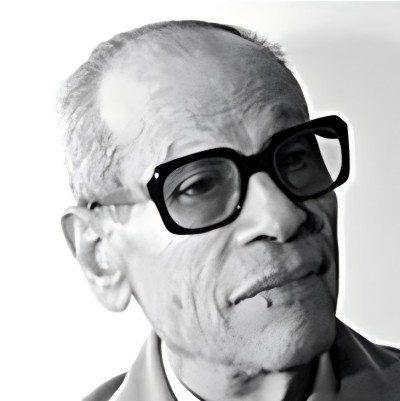
Naguib Mahfouz Abdel Aziz Ibrahim Ahmed Al-Basha (1911–2006) was an Egyptian writer and the first Egyptian and Arab to win the Nobel Prize in Literature. Mahfouz began writing in the 1930s and continued until 2004. All of his novels are set in Egypt and often feature a recurring motif: the alleyway, which symbolizes the world. He wrote over thirty novels, most of which gained fame and were adapted into films or television series. His first novel was The Game of Fates (1939), and his last was Qushtumar (1988). He also wrote more than twenty short stories, with his final one being Dreams of the Convalescence Period (2004). Among his most famous works are The Beginning and the End (1949), The Cairo Trilogy (1956–1957), Children of the Alley (1959)—which was banned in Egypt for many years after its publication—The Thief and the Dogs (1961), Adrift on the Nile (1966), Karnak Café (1974), and The Harafish (1977). While Mahfouz's literature is classified as realist, existential themes often emerge in his works. Mahfouz is the Arab author whose works have been most frequently adapted into films and television series.
Mahfouz was given his compound name in honor of the renowned physician Naguib Pasha Mahfouz, who oversaw his difficult birth.
Mahfouz's literary career is intertwined with the history of the modern novel in Egypt and the Arab world. At the beginning of the 20th century, the Arabic novel took its first steps in a society and culture that discovered this literary genre through translations of 19th-century European novels. However, for Mahfouz, a strong and ancient society like Egypt's, which preserved its traditions while modernizing, could absorb and integrate aspects of Western culture without fear. This is because Mahfouz, above all, listened to the Egyptian people, their intimate experiences, and their history in his work.
Mahfouz's novels are characterized by a classic narrative style, focusing on portraying characters and situations with intense realism. His works emphasize the customs, traditions, and social values of Egyptian society, offering a precise depiction of daily life in Egypt. Mahfouz also employs the technique of internal narration, allowing readers to see the world through the eyes of a central character. His style is further distinguished by its manipulation of time and its focus on the changes that occur in events and characters over time.
Naguib Mahfouz was born on December 11, 1911, in the Gamaliya district of Cairo. His father, a civil servant, had read no book in his life other than the Quran and The Talk of Isa ibn Hisham, as its author, Al-Muwailihi, was a friend of his. His mother, Fatima Mustafa Qashisha, was the daughter of Sheikh Mustafa Qashisha, an Al-Azhar scholar. Mahfouz was the youngest of his siblings, and because the age gap between him and his closest sibling was ten years, he was treated as an only child. He was closer to his mother than to his father, who was often busy and away from home for work. He remained close to her throughout his childhood and adulthood until her death in 1968, the same year he received the State Merit Award. He was seven years old when the 1919 Revolution broke out, an event that deeply influenced him and which he later recalled in Palace Walk, the first part of his trilogy.
Mahfouz attended a kuttab (Quranic school) to learn reading and writing, then pursued general education and enrolled in the Faculty of Arts at Fouad I University (now Cairo University) in 1930, where he earned a bachelor's degree in philosophy. He later began preparing a master's thesis on beauty in Islamic philosophy but changed his mind due to work commitments and decided to focus on literature. He joined the civil service, working as a parliamentary secretary in the Ministry of Endowments (1938–1945), then as director of the Ministry's Good Loan Foundation until 1954. He later served as director of the Minister of Guidance's office, then moved to the Ministry of Culture as director of censorship for artistic works. In 1960, he became the general director of the Film Support Foundation, then an advisor to the General Organization for Cinema, Radio, and Television. His last government position was chairman of the board of the General Cinema Organization (1966–1971), after which he retired and became a columnist for Al-Ahram.
Mahfouz married Atiyatallah Ibrahim during his hiatus from writing after the 1952 Revolution. He kept his marriage a secret from those around him for ten years, claiming that he was too busy caring for his mother and his widowed sister and her children. During this period, his income increased from writing film scripts, and he had enough money to start a family. He hid his marriage from his mother to avoid upsetting her, as she had arranged for him to marry a wealthy relative. Initially, he lived with his wife on a houseboat on the Nile, where they had their first daughter, Umm Kulthum. They later moved to an apartment on the Nile, where their second daughter, Fatima, was born. His marriage remained unknown until ten years later, when one of his daughters had a quarrel with a classmate, and the poet Salah Jahin learned of it from the classmate's parent. The news then spread among acquaintances.
Before marrying Atiyatallah, Mahfouz experienced several failed love affairs, which led him to frequent brothels and surrender to that lifestyle, fleeing from the anticipated failure of another love story. He said of that period in a press interview: "I was a regular visitor to both official and secret brothels, as well as salons and cabarets. Anyone who saw me at that time would think that someone living such a turbulent life could not possibly know love or marriage... My view of women at that time was purely sexual, with no room for emotions or feelings."
Mahfouz drew inspiration from the Gamaliya district and its surroundings for most of his novels and short stories, which formed his unique world and propelled him to international fame. He began writing in the mid-1930s, publishing his short stories in Al-Risala magazine. His first published story was Whisper of Madness in 1938. In 1939, he published his first novel, The Game of Fates, which introduced his concept of historical realism. He then published The Struggle of Thebes in 1944 and Rhadopis of Nubia in 1943, completing a historical trilogy set in the time of the pharaohs. Starting in 1945, Mahfouz embarked on his realist novelistic path, which he maintained for most of his literary career, with Cairo Modern (1945), followed by Khan al-Khalili (1945) and Midaq Alley (1947). He experimented with psychological realism in The Mirage (1948), then returned to social realism with The Beginning and the End (1949) and The Cairo Trilogy (1956–1957). Later, he turned to symbolism in novels like The Beggar (1965) and Children of the Alley (1959), which sparked strong reactions and led to an assassination attempt on his life. In the later stages of his career, he explored new concepts such as writing on the edge of fantasy, as seen in The Harafish (1977) and Arabian Nights and Days (1982), as well as mystical confessions and dreams, as in Echoes of an Autobiography (1994) and Dreams of the Convalescence Period (2004), both characterized by poetic condensation and linguistic experimentation. Mahfouz's works can be seen as a mirror of the social and political life in Egypt, as well as a contemporary documentation of human existence and the human condition in a world that seems to have abandoned or been abandoned by God. They also reflect the views of intellectuals of various inclinations toward authority.