
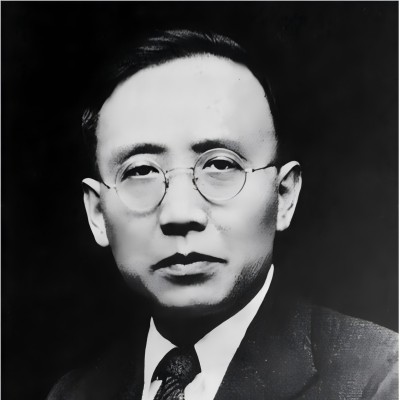
Guo Moruo(1892-1978), originally named Guo Kaizhen, courtesy name Dingtang, pseudonym Shangwu, and childhood name Wenbao, was an outstanding Chinese writer, poet, playwright, historian, archaeologist, paleographer, thinker, calligrapher, and politician. He was one of the founders of modern Chinese poetry, a pioneer and foundational figure in Chinese historical drama, a trailblazer in the materialist conception of history in China, one of the "Four Halls of Oracle Bone Studies," and a member of the first class of the Academia Sinica. After 1949, he served as the first president of the Chinese Academy of Sciences, Vice Premier of the Government Administration Council and Director of the Culture and Education Committee, Vice Chairman of the Standing Committee of the National People's Congress, the first chairman of the China Federation of Literary and Art Circles, and the founding president of the University of Science and Technology of China.
Guo Moruo was born on November 16, 1892, in Shawan, Leshan, Sichuan Province. In January 1914, he went to Japan to study. In 1915, he entered the Sixth Higher School in Okayama. In 1918, he advanced to the Medical Department of Kyushu Imperial University. In 1919, he organized the patriotic society Xia She; in the same year, he wrote poems such as Holding My Child and Bathing in Hakata Bay and The Nirvana of the Phoenix. In August 1921, his poetry collection The Goddesses was published. In 1927, he joined the Chinese Communist Party. In 1931, he completed works such as Research on Oracle Bone Script and Studies on Bronze Inscriptions from the Shang and Zhou Dynasties. In 1937, following the full outbreak of the War of Resistance against Japan, he returned to China to join the war effort and founded the National Salvation Daily in Shanghai. In April 1938, he became the director of the Third Department of the Political Department of the National Military Council. In December 1941, he completed the five-act historical play The Twin Flowers. In 1942, he finished the historical plays Qu Yuan, Tiger Tally, Gao Jianli, and The Peacock Gallbladder. In 1943, he completed the historical play Southern Crown Grass. In 1944, he wrote The Three Hundredth Anniversary of the Fall of the Ming Dynasty. In 1959, he completed the historical play Cai Wenji. In January 1960, he finished the historical play Empress Wu Zetian. In 1969, he completed the work Li Bai and Du Fu. In 1973, his work A Few Notes on Unearthed Cultural Relics was published. He edited Drafts of Chinese History and Collected Oracle Bone Inscriptions, and his complete works were compiled into the 38-volume Complete Works of Guo Moruo.
Guo Moruo passed away on June 12, 1978, in Beijing due to illness, at the age of 86.
Family
Guo Moruo, originally named Guo Kaizhen, was born on November 10 or 16 in the small town of Shawan, Leshan, Sichuan Province. Shawan is located on the Dadu River, about 40 kilometers from the former Jiading Prefecture (now the central urban area of Leshan).
At the time of Guo's birth, Shawan was a town consisting of about 180 households.
Guo's ancestors were Hakka people from Ninghua County, Tingzhou Prefecture, Fujian Province. In the latter half of the 17th century, they migrated to Sichuan after the population of the region was decimated by the rebellion led by Zhang Xianzhong (circa 1605–1647). According to family legend, the only possessions Guo's ancestors brought to Sichuan were the items they could carry on their backs. Guo's great-great-grandfather, Guo Xianlin, was the first to bring prosperity to the family. His descendants established the Guo family as leaders in the local river transport industry, which was of great importance in the region. Only then were members of the Guo family able to send their children to school.
Life
Guo Moruo was born into a wealthy family. In 1914, he left his wife and traveled to Japan to study medicine. There, he became involved with a Japanese woman and lived with her. He abandoned his medical studies and turned his attention to literature, spending much of his time learning other languages. He read the works of many great thinkers, including Spinoza, Goethe, Tagore, and Walt Whitman, who greatly influenced him. In 1921, he wrote his first poetry collection, The Goddesses. Guo Moruo was known for his influence on young people.
Poetry, Novels, and Plays
1921: The Goddesses: A Collection of Dramatic Poetry
English translation: Selected Poems from The Goddesses, translated by A. C. Barnes and John Lester, Beijing: Foreign Languages Press, 1958.
1926, 1932: Olives, Shanghai: Creation Society Publishing House, 1929 (Series: Creation Society Series).
1928, 1932: Fallen Leaves: A Collection of Novels and Plays by Moruo, Shanghai: New China Bookstore, 1932.
1936: Qu Yuan: A Play in Five Acts
English translation: Qu Yuan: A Play in Five Acts, translated by Yang Xianyi and Gladys Yang, Beijing: Foreign Languages Press, 1953; 2nd edition, 1978; Honolulu: University Press of the Pacific, 2001.
1946: Under the Moonlight, published in The China Magazine (formerly China at War), June 1946; reprinted in Stories of China at War, edited by Chi-Chen Wang, Columbia University Press, 1947; reprinted: Westport, Conn.: Greenwood Press, 1975.
1947: Laughter Underground, Shanghai and Beijing.
Haiyan Bookstore – a collection of short stories
1959: Ballads of the Red Flag, Beijing: Red Flag Magazine Press, 1959;
English translation: Songs of the Red Flag, translated by Yang Zhou, Beijing: Foreign Languages Press, 1961.
Autobiography
Guo Moruo wrote nine autobiographical works:
1947: My Childhood, Shanghai.
French translation: Autobiographie: Mes Années d'Enfance, translated by Pierre Ryckmans, Paris: Gallimard, 1970.
German translation: Kindheit: Autobiographie, translated by Ingo Schäfer, Frankfurt am Main: Insel, 1981.
Before and After the Revolution.
1930, 1931: The Black Cat and the Tower, Shanghai, 1930 – often referred to simply as The Black Cat.
My First Journey Beyond Kuimen.
My Student Years.
1932: Ten Years of Creation, Shanghai: Modern Bookstore, 1932.
1938: Sequel to Ten Years of Creation, Shanghai: Beixin Bookstore (Series: Creation New Publications).
On the Road of the Northern Expedition.
Hongbo Qu.
Historical, Educational, and Philosophical Treatises
1935, revised edition 1957: Corpus of Inscriptions on Bronzes from the Two Zhou Dynasties, Beijing: Science Press, 1957 (Archaeological Monograph Series, Category A).
1950: Report on Culture and Education, included in The First Year of Victory, Beijing: Foreign Languages Press.
1951: Culture and Education in New China, Beijing: Foreign Languages Press, 1951 (co-authors: Qian Junrui, Liu Zunqi, Mei Duo, Hu Yuzhi, Zhu Kezhen, and Cai Chusheng).
1982: Collected Oracle Bone Inscriptions, Shanghai: Zhonghua Book Company, 1978–1983, 13 volumes (co-edited with Hu Houxuan) – a collection of 41,956 oracle bone inscriptions from Yinxu.
1922: Johann Wolfgang von Goethe, The Sorrows of Young Werther.
1924: Omar Khayyam, Rubaiyat.
1925: Ivan Turgenev, Virgin Soil.
1926: Friedrich Schiller, Wallenstein.
1928: Friedrich Nietzsche, Thus Spoke Zarathustra.
1928: Johann Wolfgang von Goethe, Faust, Part One.
1929: Upton Sinclair, The Jungle.
1931: Karl Marx, Das Kapital.
1935: Leo Tolstoy, War and Peace.