
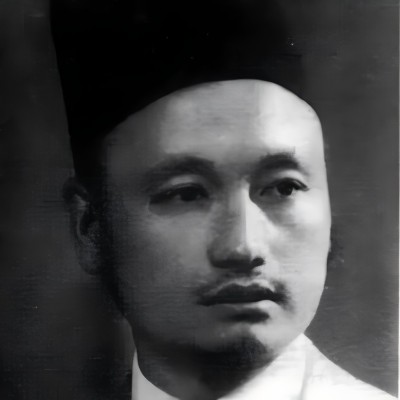
Pang Shiqian (1900–1958), courtesy name Yiwu, was a native of Sangpo, Mengzhou, Henan Province, and a renowned Chinese Islamic scholar.
In his early years, Pang Shiqian traveled to Henan, Shanxi, Gansu, and other regions to seek knowledge from teachers. In 1922, at the age of 20, he began teaching. Later, he returned to his hometown to establish a scripture school (teaching Arabic and Chinese) and participated in the founding of the "Islamic Culture Research Society" in Zhengzhou. From 1930 to 1937, he served as the Director of Moral Education at Beiping Chengda Normal School, where he also taught Arabic. In 1938, he led the "Chinese Farouk Study Mission to Egypt" to study at Al-Azhar University in Cairo, specializing in Islamic jurisprudence and Hadith. After the outbreak of the Anti-Japanese War, he led a group of Chinese students on a pilgrimage to Mecca, actively promoting China's resistance efforts. Starting in 1942, he served as the head of the Chinese Students in Egypt Department and was honored as an advisor on Eastern Affairs to King Farouk of Egypt, as well as a lecturer on Chinese culture at Al-Azhar University. After returning to China in 1947, he participated in the establishment of the Islamic Seminary in Beiping and taught there. He also co-founded the "Yuehua Cultural Service Society" and served as the editor-in-chief of Yuehua magazine and Yuehua Weekly. Additionally, he held a part-time professorship in Arabic at Beiping Normal University. In 1949, he taught at the Beijing Hui People's College and the China Islamic Institute. In 1952, he participated in the preparation for the establishment of the China Islamic Association and served as a member of its Standing Committee after its founding.
Pang Shiqian dedicated his life to Islamic education and academic research. His major works include China and Islam (in Arabic, Cairo edition), Nine Years in Egypt, The Evolution and Textbooks of Chinese Mosque Education, Hui Education and Students in Egypt, as well as translations such as The Mission of Peace, Schools of Islamic Thought, History of Islamic Religion, History of Islamic Jurisprudence, and Nawawi's Forty Hadiths. He was diligent in his studies and committed to reform throughout his life.
Pang Shiqian advocated for "balancing both this life and the hereafter," promoting the improvement of real-life conditions. He was dedicated to reforming traditional mosque education, advocating for the inclusion of scientific and cultural courses alongside religious studies to "modernize the learning of Arabic" so that students could "read newspapers, write letters, compose essays, and speak fluently." He proposed adding Chinese textbooks for children in religious schools and personally compiled new-style Arabic textbooks for elementary education. He emphasized a modern perspective in comprehensively studying Islamic culture, valued rational knowledge, and opposed using myths and legends as the basis for academic research. He stressed the importance of adapting to the times and local conditions, advocating adherence to the spirit of Islamic scriptures while avoiding rigid traditionalism. He led by example in promoting the translation of Islamic scriptures and texts into Chinese.