
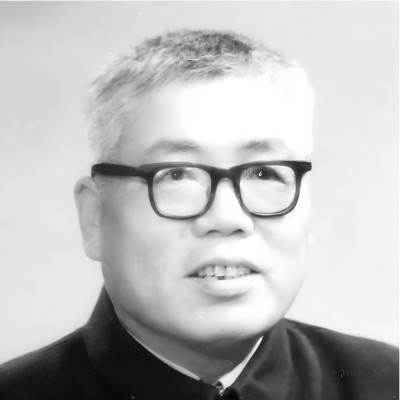
Geng Shimin (1929–2012) was a native of Xuzhou, Jiangsu Province, and a professor at the Minzu University of China. He was a renowned philologist of ancient Turkic languages, a Turkologist, and a Uyghur studies scholar, as well as the founder of the Kazakh language and literature discipline in China.
Geng attended a missionary school in Xuzhou during his secondary education. After graduating from high school in 1948, he studied French for one year in the preparatory program at Aurora University in Shanghai. In 1949, he was admitted to the Department of Oriental Languages and Literatures at Peking University, majoring in Uyghur. In 1952, during the nationwide restructuring of higher education institutions, he transferred to the Department of Ethnic Languages and Literatures at the Central Institute for Nationalities (now Minzu University of China), continuing his studies in Uyghur. After graduating in 1953, he remained at the institute as a faculty member, eventually becoming a professor and doctoral advisor. He also served as the honorary president of the Altaic Languages Branch of the Chinese Ethnic Languages Society and vice president of the Chinese Turkic Studies Association. In 1992, he was awarded the "International Renowned Scholar Prize" by the Alexander von Humboldt Foundation in Germany. In 2000, he received the Gold Medal from the Permanent International Altaistic Conference (PIAC).
Geng was primarily engaged in teaching and research on ethnic languages. He was proficient in numerous ancient and modern Turkic languages, as well as foreign languages such as English, Russian, German, and Japanese. In 1952, he traveled to the Ili and Tacheng regions of Xinjiang to conduct surveys on Uyghur and Kazakh languages.
Born in 1929 in Xuzhou, Jiangsu Province, Geng Shimin graduated from the Department of Oriental Languages at Peking University in 1952. He was among the first generation of ethnic philologists in New China and the first Chinese scholar to study ancient Turkic languages. He published millions of words of research and translations in multiple languages and received numerous awards for outstanding research achievements from institutions such as the Chinese Academy of Social Sciences. Proficient in Uyghur, Kazakh, Turkish, Tocharian, and other ancient and modern Turkic languages, as well as English, Russian, German, French, and Japanese, Geng was an internationally renowned philologist of ancient Turkic languages and a pioneer in the field in China. His extensive body of work and recognition from domestic and international academic institutions brought significant breakthroughs to the study of ancient Turkic philology in China and earned him a prestigious reputation in the global academic community.
In 1950, a French youth delegation visited Peking University for six months, during which Geng successfully completed the task of French translation.
Since most literature in the field of ancient Turkic-Uyghur philology was published in German, proficiency in German was crucial for studying ancient Turkic languages. Geng mastered German exceptionally well, publishing numerous works and translations in the language. He was also invited multiple times to lecture and conduct academic exchanges at several renowned universities in Germany.
Geng was also the first in China to discover Tuvan, the oldest Turkic language. During a 1956 survey of Kazakh dialects in Xinjiang, he identified the local language as Tuvan, an ancient Turkic language with no written records. He transcribed this firsthand material using the International Phonetic Alphabet and Turkic script. Later, he traveled to Gansu and Qinghai, where he discovered the unwritten languages of the Yugur and Salar peoples. These findings, which Geng termed "field languages" of ancient Turkic, immediately attracted the attention of scholars worldwide. Despite having only foreign textbooks and dictionaries, Geng successfully entered this field.
In 1959, Geng Shimin completed the translation of The Maitrisimit on his own. Later, he became the first to directly translate the text of Kutadgu Bilig (Wisdom of Royal Glory), an 11th-century work by the renowned Uyghur scholar Yusuf Khass Hajib, into Chinese, English, French, German, and Japanese. In 1976, he compiled China's first systematic set of textbooks on ancient Turkic-Uyghur languages, including Selected Readings of Ancient Turkic Inscriptions, Selected Readings of Ancient Turkic-Uyghur Texts, Selected Readings of Texts from the Kara-Khanid Khanate Period, and Selected Readings of Ancient Turkic-Uyghur Literature, totaling eight volumes. He published 23 monographs in Chinese, English, and German, such as An Introduction to Ancient Uyghur Culture and Literature, Studies on the Uyghur Maitrisimit, and An Introduction to Dunhuang Turkic and Uyghur Documents. He also authored over 160 papers in Chinese, Uyghur, English, French, German, and Japanese, including Studies on the Uyghur Inscription of the Idiqut Khocho King's Meritorious Deeds and Studies on the Uyghur Abhidharma Fragments. Six of his works received first and second prizes for outstanding research achievements from the Chinese Academy of Social Sciences, the State Ethnic Affairs Commission, and the Beijing Municipal Government. Additionally, he translated 17 renowned works by international scholars, including Ancient Turkic Grammar and A Cultural History of the Western Regions, originally written in French, German, English, Japanese, and Russian.